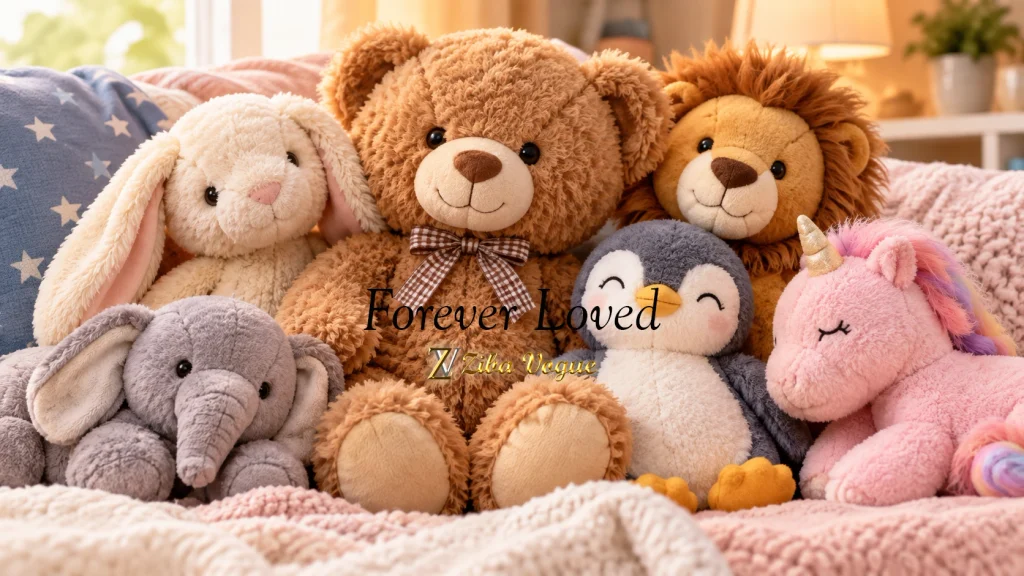
There is something almost funny about the way we treat stuffed toys as a childhood thing. We expect children to have them, sleep beside them, carry them around and become deeply attached to them. Then, somewhere along the way, we are supposed to outgrow them. The teddy bear goes into a box. The favourite little animal is left on a shelf. We become adults, our rooms change, our lives become busier, and somehow the things that once made us feel safe are expected to become unnecessary.
And yet, they rarely disappear completely.
Walk into an adult’s bedroom and you may still find a plush toy sitting quietly on a chair. There might be a small character beside a computer, a soft animal tucked into the corner of a sofa, or an old teddy bear that has survived several moves and somehow still has a place. It may no longer be something they play with. It may simply be something they cannot imagine throwing away.
Perhaps that is the more interesting question: why do we keep loving soft things even after we stop thinking of ourselves as children?
We Don’t Always Keep the Toy. We Keep the Feeling.
A stuffed toy can begin as something very ordinary. A birthday present. A surprise from a parent. Something chosen from a shop because a child pointed at it. A little companion bought during a holiday.
But objects have a strange way of collecting meaning.
After enough time, the toy stops being just a toy. It becomes connected to a room, a person, a particular age or a version of ourselves that no longer exists in quite the same way. The teddy bear may remind someone of their childhood bedroom. A small plush animal might bring back memories of a grandparent who gave it to them. Even an inexpensive toy can become precious when it carries a story that cannot be bought again.
That is why telling someone to simply throw it away can feel surprisingly difficult.
You are not really asking them to get rid of a stuffed animal. You are asking them to let go of everything they associate with it.
Childhood Has a Longer Memory Than We Think
Children often give their toys personalities without being taught to do so. A stuffed rabbit can have a name. A bear can have a favourite place on the bed. A little character can become the companion who listens to every secret, survives every tea party and is taken everywhere until one day it quietly becomes part of the furniture.
Adults may smile at this, but perhaps we understand it more than we admit.
We spend much of adulthood surrounded by things that are useful. Phones, laptops, keys, bags, furniture, appliances. They have purposes. We replace them when they stop working. Their value is usually connected to what they do.
A sentimental object works differently.
That may be one reason stuffed toys have such unusual staying power. They are not asking us to accomplish anything. They simply exist beside us.
Then We Grow Up — But the Need for Comfort Doesn’t Disappear
Growing up changes the kinds of comfort we look for, but it does not remove the need for comfort itself.
An adult may have a favourite blanket, an old sweater, a particular mug, a piece of jewellery they never take off or a photograph they keep close. These things may seem insignificant to somebody else. To the person who owns them, they can feel almost irreplaceable.
Stuffed toys belong to the same emotional world.
The difference is that adults sometimes feel embarrassed by them because we have been taught that softness, attachment and childishness belong together. We are expected to become more practical as we grow older, as though maturity means becoming less sentimental.
But being attached to something does not make us less grown-up.
If anything, the objects we choose to keep often tell us something about the parts of ourselves that have survived growing up.
An Adult Plush Toy Isn’t Necessarily a Children’s Toy
This is where the story becomes more interesting.
Adults do not necessarily buy plush toys because they want to play with them. They may choose one because it makes them smile. Because it reminds them of something. Because the character feels like an expression of their personality. Because it looks unexpectedly charming sitting on a desk. Because a difficult day feels slightly less serious when there is a ridiculous little creature beside the laptop.
Sometimes it is simply decoration.
Sometimes it is nostalgia.
Sometimes it is collecting.
Sometimes it is affection.
And sometimes there is no explanation at all beyond, “I just liked it.”
We do not demand a practical reason for every other beautiful thing we bring into our homes. A vase does not need to hold flowers every day to be worth keeping. A painting does not need to solve a problem. A beautiful piece of jewellery does not have to serve a purpose beyond making us feel something.
Perhaps plush toys deserve the same freedom.
The Smallest Gifts Can Carry the Biggest Feelings
There is another reason stuffed toys remain so closely connected to us: they are remarkably good gifts.
Giving someone a plush toy can feel different from giving something expensive or obviously practical. It often carries a softer message.
“I saw this and thought of you.”
“I thought this would make you smile.”
“I wanted you to have something to keep.”
Those messages can matter more than the price of the object itself.
A little stuffed animal given to a child can become a childhood companion. Given to a partner, it can become an inside joke or a reminder of a particular moment. Given to a friend, it can become a small symbol of affection. Given to a new baby, it can become part of the photographs and memories of those early years.
The object may be small. The story attached to it may not be.
And Then There Are the Toys We Never Planned to Keep
Most of us have something like this.
A toy we did not think was particularly important. Something that simply stayed.
It survived the move when other things were discarded. It remained on a shelf when the room changed. It was packed into a suitcase, then unpacked again years later. At some point, we stopped asking why we still had it.
It was just there.
That may be one of the quietest forms of attachment. We do not always choose the things that become keepsakes. Sometimes they become keepsakes because they stayed with us long enough to become part of the background of our lives.
And when something has been there through several versions of you, getting rid of it can feel strangely like removing a small piece of your own history.
Maybe We Don’t Outgrow Them. Maybe We Change the Way We Love Them.
A five-year-old might hug a stuffed bear every night.
A fifteen-year-old might keep a favourite character on a bedroom shelf.
A twenty-five-year-old might have a tiny plush companion beside their monitor.
A parent might keep the first toy their child loved.
A grown-up child might still have the teddy bear their mother gave them decades ago.
The relationship changes, but the affection does not necessarily disappear.
Perhaps that is the part we misunderstand when we say someone has “outgrown” a stuffed toy. We assume outgrowing means no longer needing it.
But sometimes it simply means needing it differently.
There Is Something Comforting About an Object That Asks Nothing From Us
Life becomes complicated as we grow older.
There are responsibilities, decisions, deadlines, relationships, bills and endless things demanding our attention. Even our homes can become carefully managed spaces where everything has a purpose.
A soft toy does not ask much from us.
It does not need to be impressive. It does not need to be useful. It does not need to prove anything.
It can simply sit there.
Maybe that is why a little plush companion can feel surprisingly comforting on an adult’s desk or beside a bed. It brings something uncomplicated into a world that often isn’t.
There is no achievement attached to it.
Just affection.
Some Things Are Worth Keeping Simply Because They Make Us Feel Something
We spend a great deal of time trying to make sensible decisions about what we own. We ask whether something is useful, fashionable, valuable or worth the space it occupies.
But sentimental objects follow a different logic.
A stuffed toy can be faded and slightly worn. Its fur can have lost its softness. One ear might sit differently from the other. It may have no monetary value whatsoever.
And yet someone can look at it and remember an entire part of their life.
That is a kind of value that cannot be measured very easily.
Maybe this is why we never really outgrow stuffed toys. Not because we remain children, but because becoming an adult does not mean becoming immune to tenderness.
We still want little reminders of people we love. We still enjoy things that make us smile. We still find comfort in softness. We still become attached to objects that quietly accompany us through time.
And sometimes, when the world feels particularly serious, it is rather lovely to have something completely unnecessary sitting nearby simply because it makes us happy.
The Things We Keep Say Something About Us
Perhaps the most interesting thing about sentimental objects is that they reveal parts of us that are difficult to explain.
The little plush toy on a desk might say something about someone’s sense of humour. The old teddy bear might say something about family. A favourite stuffed animal might remind someone of a person who gave it. A favourite character might bring back an entire period of life.
These objects become small pieces of personal history.
They don’t need to be expensive. They don’t need to be rare. They don’t even need to be particularly beautiful by anyone else’s standards.
They only need to mean something to the person who keeps them.
And maybe that is enough.
Because perhaps we never really outgrow stuffed toys.
We simply grow older and find new reasons to keep them.
A child keeps one because it feels like a friend. An adult might keep one because it brings back a memory, brightens a room, makes them laugh or reminds them of someone they love.
The reason changes.
The feeling remains.
And that may be the real charm of the little things we keep — not that they are important to everyone, but that somewhere along the way, they became important to us.