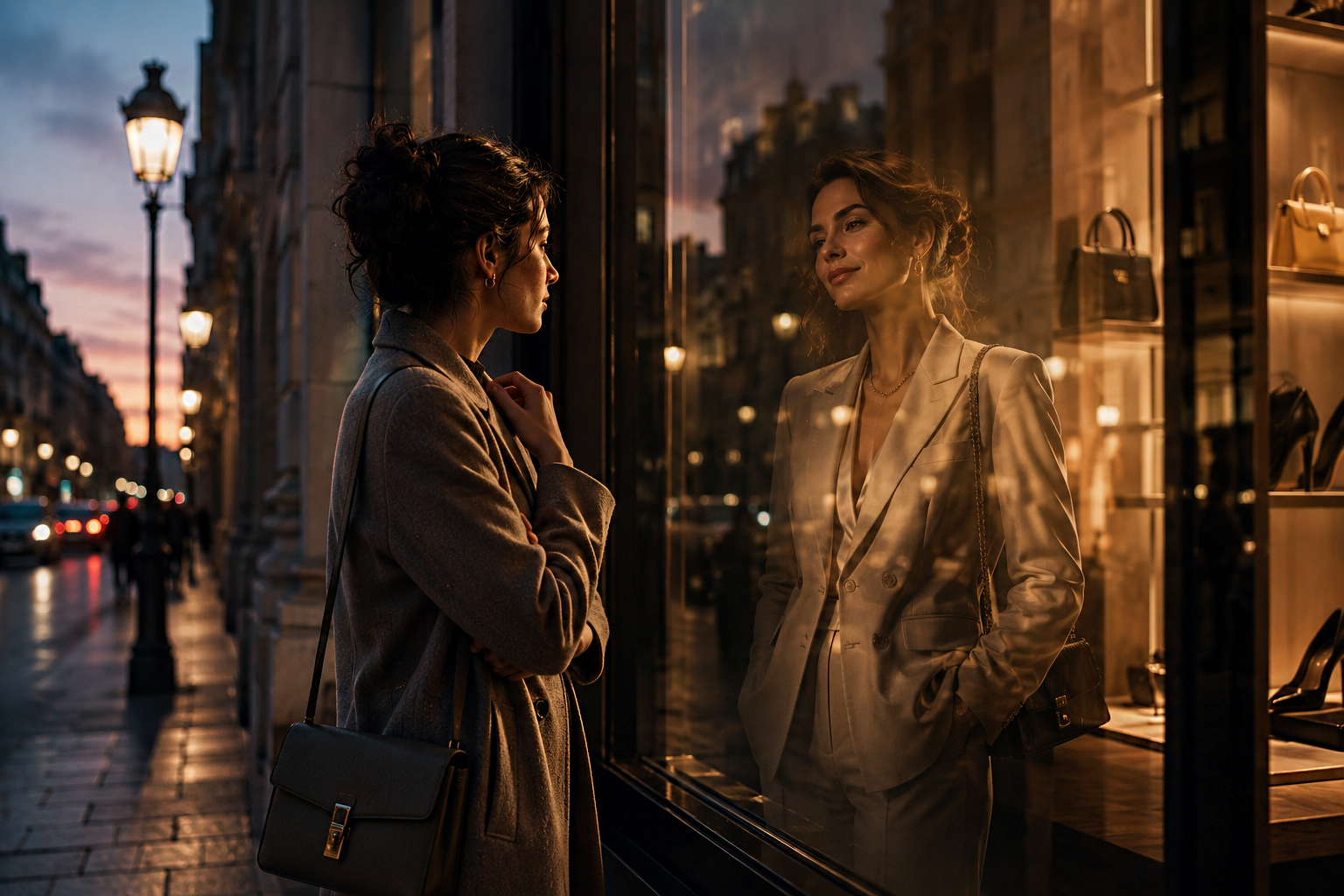
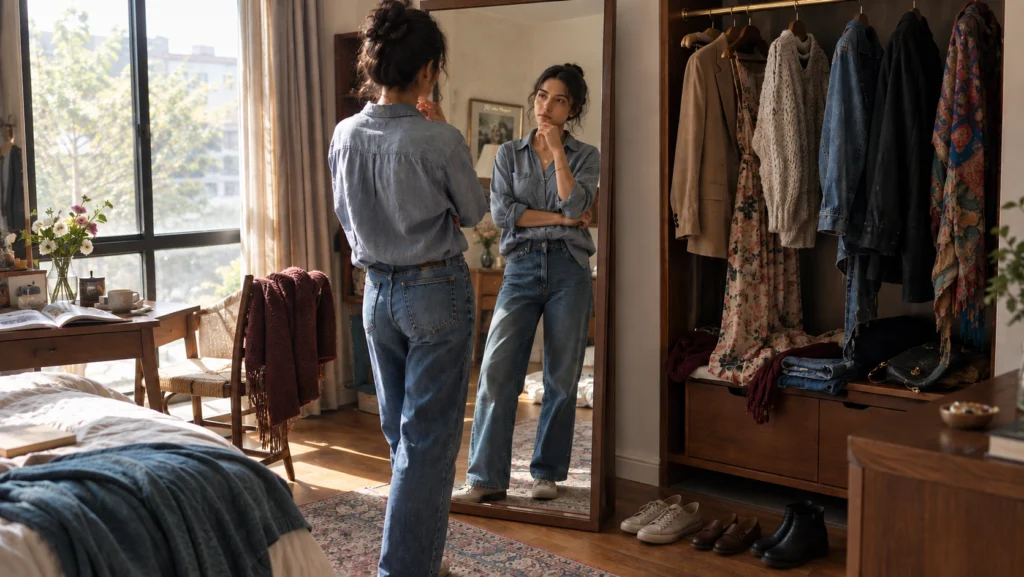
We are asked to know our personal style almost as if it were a fact about us, like our name or our favourite colour. Classic. Minimalist. Romantic. Edgy. Relaxed. Maximalist. There always seems to be a word ready to explain what a person wears. And if you cannot find yours, it can feel strangely revealing. You look at your wardrobe and find pieces you genuinely like, but they do not seem to belong to the same story. The tailored jacket you love one month sits beside a soft dress you reach for the next. There are jeans, heels, sneakers, a beautiful scarf you bought on impulse, perhaps something you once imagined would become “your thing” and now barely wear. Nothing is necessarily wrong with any of it. It simply does not add up to one obvious version of you.
Maybe that is the uncomfortable part. We have been taught to think that personal style should be recognizable before it can be real.
Fashion has made the idea of personal style sound almost like a destination. Find your aesthetic. Discover your colours. Build your signature wardrobe. Once you know what suits you, the thinking is supposed to become easier. But real life has never been that tidy. We change jobs, move through different relationships, gain confidence, lose it, discover new things, outgrow old ones and sometimes simply wake up wanting to dress differently. The woman who felt completely herself in a sharp black blazer three years ago may now feel most comfortable in an oversized sweater and worn-in jeans. Neither version is less authentic.
And this may be why having more fashion inspiration than ever has not necessarily made getting dressed easier. We have more images, more choices and more language for describing style, yet many of us still open the wardrobe and wonder what, exactly, is supposed to feel like us.
There was a time when taste had room to arrive slowly. You might notice a beautiful coat on someone walking down the street and remember it for years. You might become fascinated by the way your mother wore a particular necklace, find an old photograph and suddenly want to dress like the woman in it, or buy something from a little shop simply because it caught your eye. You did not have to know what aesthetic it belonged to. You did not have to save the image, search for similar versions or decide whether it was “you.” You wore it, lived with it, discovered what you liked about it and moved on. Taste could develop almost without announcing itself.
Now we encounter so much fashion before we have even had time to decide what we think of it. One outfit becomes another, one aesthetic leads into the next, and the same shapes, colours and styling ideas can appear often enough that they begin to feel strangely familiar. That familiarity is easy to mistake for preference. We see something repeatedly, understand its visual language, recognize the places where it belongs, and eventually it can start to feel like something we were always supposed to want.
This is where personal style gets complicated. When you save an outfit, are you saving the clothes, or are you saving the feeling around them?
Think about the photographs that accumulate on your phone. A beautifully dressed woman standing in a sunlit room. A perfectly oversized coat. A table beside a bed with a book, a coffee cup and a pair of elegant shoes. You may love the entire image without genuinely wanting the clothes. What you are responding to might be the ease of the woman, the atmosphere of the room, the suggestion of a life that feels calmer, more interesting or more put together than your own. Sometimes we do not want the outfit at all. We want the version of ourselves that the photograph seems to promise.
That is not a reason to distrust fashion inspiration. Inspiration is one of the pleasures of fashion. It can introduce us to designers we would never have discovered, show us combinations we would never have considered and take us somewhere culturally or visually unfamiliar. The problem begins when there is no space left between seeing something and wanting it. We move so quickly from one influence to the next that we rarely get the chance to ask a quieter question: do I actually like this, or have I simply become very familiar with it?
We can move through entire aesthetics now almost as quickly as we once developed a genuine preference. Soft romantic dressing gives way to oversized tailoring, then vintage denim, then quiet luxury, then something else entirely. There is nothing wrong with enjoying any of them. The strange part is the pressure to turn every passing attraction into an identity. If you like something, you are encouraged to become something: minimalist, vintage, feminine, edgy, effortless. A preference is no longer allowed to be just a preference.
But you can admire a silk skirt without wanting one in your wardrobe. You can love an oversized blazer on someone else and feel happiest in a soft cardigan. You can save dramatic jewellery while wearing the same tiny earrings every day. You can be fascinated by a trend and never participate in it. None of these things are contradictions. They are simply signs that looking at fashion and living in clothes are two different experiences.
We have become very comfortable putting people into visual categories because categories make the world easier to read. A woman who wears black becomes minimalist. Someone in vintage becomes “a vintage girl.” Delicate jewellery becomes feminine. Trainers become a signature. Eventually, we start doing the same thing to ourselves, editing our wardrobes until everything appears to belong to one carefully constructed identity.
But people are much less tidy than that. You can dress beautifully for dinner and spend the following day in an old shirt you have owned for ten years. You can love fashion and still want your clothes to disappear into your life. You can be drawn to colour and suddenly spend an entire month wearing neutrals. You can want sharp tailoring one morning and something loose and almost shapeless the next. Your clothes can respond to your mood, your work, your body, the weather, your age or simply the kind of day you are having.
None of that makes your style less personal.
Some people do have a recognizable way of dressing. They return to the same colours, shapes or details so often that those choices become part of how others remember them. But repetition is only one way style can reveal itself. For someone else, it may be a preference for softness, a particular kind of fabric, unusual jewellery, simple silhouettes or the habit of combining something old with something new. And sometimes there is no clear pattern yet.
That is not a failure. You do not have to arrive at a finished version of your style by a certain age, or choose an aesthetic simply because everyone else seems to have one. You are allowed to still be noticing. You are allowed to change your mind. You are allowed to like things that do not belong together. Personal style may begin not with choosing a category, but with paying closer attention to what you actually want to wear.
You do not suddenly arrive at a certain age and receive a finished personal style. Your twenties do not have to look like your thirties, and the wardrobe you love at forty may have very little in common with the one you wore at twenty-five. Clothing changes because we change, sometimes deliberately and sometimes without even noticing.
The clothes we wear in ordinary moments can reveal more than the outfits we carefully photograph. Think about the sweater you reach for at home, the coat you have worn for years, the earrings you put on without thinking, the shoes you know you can actually walk in, or the colour you keep choosing even though nobody has declared it fashionable this season. These things may not look particularly significant from the outside, but they often reveal preferences that have survived without needing an audience.
When there is nothing to perform, something different happens. We stop dressing for the image and start dressing for the experience of being ourselves. We choose what feels comfortable, familiar, beautiful or simply right. There is no photograph to capture, no trend to prove and no one else to impress. That may be one of the quieter places where personal style begins.
There is another clue hiding in our wardrobes: the clothes we admire but never wear. Most of us have them. The dress bought for a life we imagined having. The shoes that looked extraordinary in a photograph but never seem right once they are on our feet. The beautiful blouse that somehow requires a confidence we do not feel every morning. The piece we bought because we thought becoming a slightly different person might be as simple as getting dressed differently.
We are not always buying clothes for who we are. Sometimes we are buying them for who we imagine we could become.
There is nothing particularly foolish about that. Clothing has always carried dreams as well as practical purpose. We dress for new beginnings, for confidence, for romance, for reinvention. A new coat can make us feel ready for a different life. A dress can make us imagine ourselves in rooms we have never entered. Sometimes the imagined version of ourselves eventually becomes real. Sometimes she disappears, and the clothes remain behind as evidence that we once wanted something different.
This may be one reason a person can have a wardrobe full of clothes and still feel that there is nothing to wear. The problem may not be quantity. It may be that the wardrobe contains too many versions of the self at once: who we were, who we thought we would become and who we are now.
They do not all have to agree.
The internet adds another layer because clothing is no longer experienced only in the mirror. We see ourselves through photographs, videos and other people’s reactions. We learn which outfits look impressive on camera, which combinations attract attention and which details are immediately recognized as fashionable. After enough exposure, it can become surprisingly difficult to tell the difference between “I like this” and “I like how this makes me look.”
Those are not always the same thing.
There is a difference between saying, “I look good in this,” and saying, “I feel like myself in this.” Sometimes they happen together. Sometimes they do not. The first is about appearance; the second is about recognition. It is the feeling that the clothes have somehow stopped being a costume and become part of you.
That may be a more useful way to think about personal style.
Instead of asking, “What is my personal style?”, we could start with smaller questions. What do I reach for without thinking? What makes me feel comfortable without making me disappear? Which clothes do I keep buying again? Which pieces make me stand a little differently? Which trends do I admire but never actually want to wear? What have I kept long after fashion moved on?
These questions are less glamorous than a style quiz, but they may tell us considerably more.
Your style might already be there, only without a convenient name. It could be in your preference for softer fabrics, the piece of jewellery you wear almost every day, the way you combine something old with something new, or your instinct to buy one beautiful coat instead of five fashionable ones. It could even be in the shoes you refuse to replace because, somewhere along the way, they became part of your life.
Personal style does not always announce itself. Sometimes it is almost invisible to everyone except you.
That may be why trying so hard to “find” a personal style can become exhausting. We keep looking for something distinctive enough to identify, while our real preferences may be much quieter. We expect our wardrobe to make a statement when perhaps it is simply meant to make sense to us.
You do not need a signature look. You do not need a wardrobe that fits neatly into one aesthetic. You can be drawn to tailoring one year and softness the next. You can love colour and still spend a month in neutrals. You can dress differently because your mood is different, because your life has changed, or because you simply woke up wanting something else.
Fashion gives us the freedom to play with those possibilities. It does not have to become another identity we are expected to maintain.
So if you still cannot define your personal style, stop trying to name it for a moment. Look instead at what you actually wear. Notice what makes you feel comfortable, beautiful, confident or quietly yourself. Pay attention to the pieces you return to. Notice what stays after the trends have moved on.
There may already be more of an answer there than you think.
And if you still cannot define it, that is fine too. You do not owe anyone a wardrobe with a perfectly coherent aesthetic. You do not have to turn your taste into a label simply because labels make fashion easier to talk about.
You can keep choosing.
Because personal style may never have been something we were meant to discover once and preserve forever. It may be the quiet accumulation of choices we make as we move through life — what we keep, what we leave behind, what unexpectedly becomes important and what we eventually realize was never really ours.
In a world that is constantly telling us what to want, there is something deeply personal about taking the time to decide for yourself.
Maybe knowing what does not feel like you is already the beginning of knowing what does.