You can usually tell when something was made by hand.
Not always immediately. Sometimes it is only a tiny detail — a stitch that isn’t perfectly even, a shape that varies slightly from one piece to another, a surface that carries the faint evidence of being worked rather than manufactured.
Nothing is wrong with it.
In fact, that may be exactly why we like it.
We live among an extraordinary number of identical things. The same shoes, the same bags, the same jewellery, the same furniture, the same objects appearing again and again on our screens until we can almost forget what it feels like to encounter something that exists only once in quite the same way.
Then we come across something handmade.
And somehow, we look at it differently.
It Doesn’t Look Exactly Like Everything Else
There is a particular pleasure in finding something that has not been produced to look perfectly interchangeable.
A handmade piece may have a slightly different curve, an unexpected combination of colours or a small irregularity that would probably be corrected in a factory.
Instead of making it less appealing, these details can give it character.
We are used to perfection being presented as the goal. Smooth surfaces. Exact measurements. Identical finishes.
But when something is handmade, variation becomes part of its identity.
Two pieces can come from the same design and still feel like individuals.
That is a surprisingly beautiful idea.
You Can See the Time in It
We rarely think about time when we buy something.
The finished object is what catches our attention first. We decide whether we like it, consider the price, and eventually take it home. But with handmade things, the making can remain visible. The finished piece still carries a sense of the process behind it.
The making has already disappeared.
Handmade things can make that process harder to ignore.
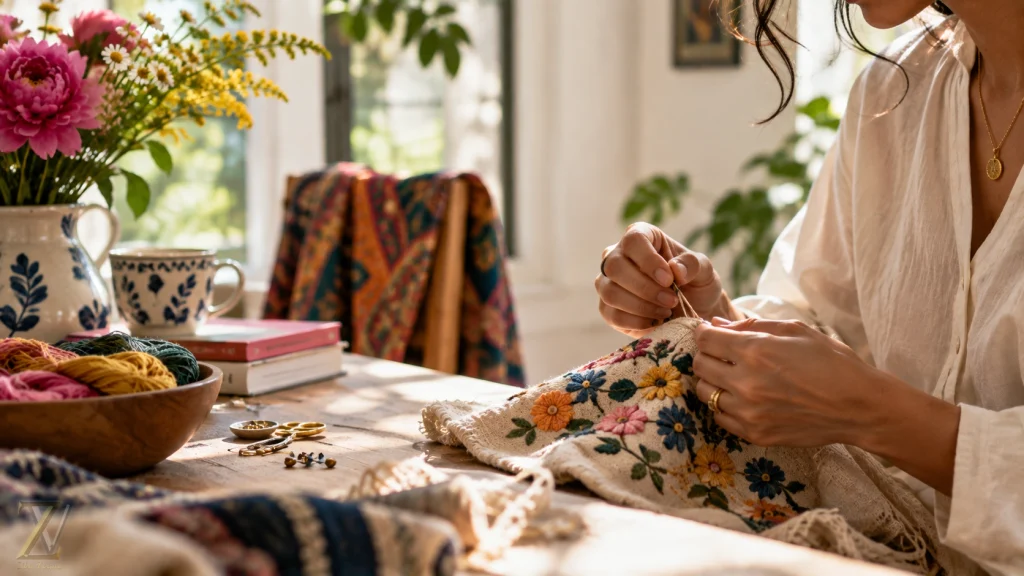
A crocheted flower contains every loop of yarn. A hand-stitched piece carries every movement of the needle. A woven textile reflects countless crossings of thread. A small ceramic object has passed through someone’s hands before becoming the thing we eventually see.
You may never know exactly how long it took.
But you can sense that it took time.
And time changes the way we look at an object.
Imperfection Can Be Its Most Beautiful Detail
There is something almost refreshing about an object that doesn’t pretend to be flawless.
A handmade piece can be slightly uneven.
The stitching might not follow a perfectly mechanical line. The colours may meet in a way that was never exactly repeated. A tiny variation might distinguish one piece from another.
In a world filled with polished images and carefully corrected surfaces, these imperfections can feel remarkably honest.
They tell us that a person was involved.
Not a person as an abstract idea, but an actual pair of hands making decisions along the way.
Perhaps that is why handmade things can feel warmer.
Their imperfections are not defects waiting to be hidden.
They are evidence.
The Mystery of the Person Behind It
One of the most interesting things about handmade objects is that they can make us think about someone we have never met.
Who chose that colour?
What made that particular shape feel right?
Perhaps someone experimented with several ideas before arriving at this one.
The finished piece gives us only a glimpse of that process, but somehow, we can imagine the person behind it.
What did their workspace look like?
Were they listening to music? Drinking tea? Making something late at night? Starting again because the first attempt wasn’t quite right?
We don’t usually ask these questions about something that came off a production line.
But handmade objects can leave enough traces of their making to make us curious. The person behind the object remains invisible, yet somehow present.
Why We Notice Handmade Things More Now
There is an interesting contradiction in modern life.
Technology has made almost everything easier to reproduce, customise and deliver. We can find thousands of versions of almost anything with a few taps.
At the same time, many people are becoming more interested in things that feel individual.
Not necessarily rare.
Not necessarily expensive.
Just less anonymous.
This helps explain the appeal of craft, independent makers, small-batch work and objects that show some evidence of the person who made them.
The attraction isn’t simply that something is “old-fashioned.”
It may be that handmade objects offer something increasingly difficult to find:a sense of difference.
Handmade Doesn’t Have to Mean Perfectly Rustic
Handmade is sometimes presented through a very particular visual language: natural linen, earthy colours, rustic kitchens and carefully arranged baskets.
But handmade can be much more contemporary than that.
A brightly coloured crochet piece can feel playful and modern. A sculptural ceramic can look almost architectural. Hand-beaded jewellery can be striking against a minimalist outfit. A small embroidered detail can completely change the character of an otherwise simple piece.
Craft does not belong to one aesthetic.
It can be romantic, bold, playful, refined, eccentric or quietly beautiful.
And that is where handmade becomes particularly interesting for personal style.
When Something Doesn’t Look Like It Belongs to Everyone
Fashion has always had a relationship with individuality.
We use clothes and accessories to make choices about how we want to appear, but personal style is rarely created by following a formula perfectly. It comes from the unexpected combinations — the piece that doesn’t quite match, the old accessory worn with something new, the small detail that makes an outfit feel unmistakably yours.
Handmade pieces can work in much the same way.
A crochet flower attached to a bag. A hand-beaded bracelet with a crisp shirt. A small crafted charm hanging from a handbag. A colourful textile paired with an otherwise minimal outfit.
The point isn’t that handmade automatically makes something more stylish.
It is that it can introduce something less predictable.
And sometimes that is all an outfit needs.
The Pleasure of Knowing There Isn’t Another One Exactly Like Yours
There is a subtle difference between owning something beautiful and owning something that feels like it belongs specifically to you.
Mass production gives us extraordinary access and choice. That is something worth appreciating.
But abundance can also make everything feel replaceable.
Handmade objects push gently in the other direction.
Even when several pieces are made from the same pattern, no two may be completely identical.
That small difference can create a strange sense of attachment.
You aren’t simply looking at a piece.
You are looking at your piece.
Maybe We Don’t Love the Imperfection — Maybe We Love the Evidence
This is perhaps what makes handmade things so compelling.
It isn’t necessarily the uneven stitch or the slightly irregular shape that we love.
It is what those details tell us.
There is time in this object.
Care went into its details. Raw materials were transformed, gradually and deliberately, into something we can hold, wear or keep.
That human effort may be invisible at first, but it is often what makes a handmade piece feel so personal.
There is a quiet intimacy in that.
The object carries a trace of its making, even after the maker has disappeared from the scene.
And perhaps that is why handmade things can feel different before we can explain why.
They remind us that not everything meaningful needs to be perfectly finished, perfectly identical or endlessly reproduced.
Some things become more interesting because a human being was there.
And in a world where almost everything can be copied, there is something beautiful about holding onto the evidence that someone, somewhere, made this one by hand.