WHY SOME THINGS
BECOME KEEPSAKES
The objects we keep often hold
memories we cannot replace.
There are things in our homes that make very little sense on paper.
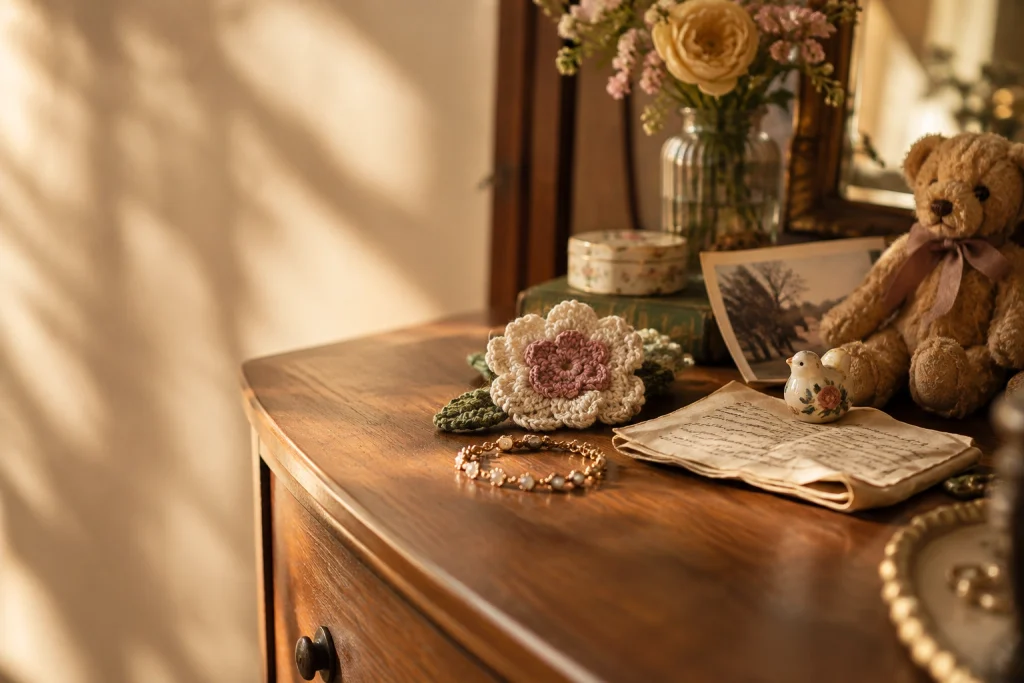
A faded note. A tiny ornament. A bracelet that is no longer worn. A soft toy from years ago. A little object picked up during a trip, or something handmade by someone who probably never imagined we would keep it for this long.
None of these things necessarily have much monetary value. Yet we hesitate to throw them away.
We keep them because, somewhere along the way, they stopped being things.
They became reminders.
A keepsake carries a strange kind of weight. It can bring back a particular afternoon, a person we once knew, a place we visited, or simply a version of ourselves that existed at a different point in life. Sometimes we cannot even remember exactly why we kept something. We only know that losing it would feel different from losing an ordinary possession.
Perhaps that is what makes keepsakes so interesting. Their meaning is rarely visible from the outside.
When an Object Holds a Memory
We often talk about possessions in practical terms. Is it useful? Is it beautiful? Is it worth the space it takes up?
Keepsakes operate by completely different rules.
Their value comes from association rather than function. A small object can become important because it belongs to a particular memory. The object itself may be ordinary, but the story attached to it is not.
This is why two people can look at the same thing and see completely different worlds.
One person sees an old piece of jewellery. Another sees the first gift someone gave them. One sees a faded photograph. Another sees a home that no longer exists. One sees a little handmade figure sitting on a shelf. Another sees the person who gave it to them.
The object becomes a kind of quiet container for memory.
We Don’t Always Choose What Becomes Meaningful
What becomes a keepsake is rarely planned.
We may carefully buy something because we think it will last, only to forget about it within a few months. Meanwhile, something completely unexpected becomes the thing we cannot part with.
A small gift from a friend. A souvenir bought without much thought. A piece of jewellery worn during an important period of life. Even a simple object from an ordinary day can acquire meaning later.
This is partly because memory does not always follow importance.Some of our most treasured memories come from moments that seemed insignificant when they were happening. A late conversation. A particular summer. A familiar room. A day spent with someone before life changed.
Sometimes the object survives simply because it was there.
The Appeal of Something Personal
There is also something deeply satisfying about owning things that feel personal rather than interchangeable.
Modern shopping has made it remarkably easy to find almost anything. We can replace, upgrade and reorder with very little effort. But abundance can also make possessions feel strangely anonymous.
A keepsake offers the opposite experience.
It has a history.
It may not be the most fashionable thing in the room, and it may not fit neatly into a particular aesthetic. But it belongs to us in a way that something chosen only because it was trending never quite can.
This may be one reason handmade objects often carry a particular charm. A handmade piece can show small variations, imperfections and traces of the person who made it. It feels less anonymous.
Not because perfection has no value, but because something made with a human touch can feel easier to connect with.
What We Keep Says Something About Us
Our personal style is often discussed through clothes, jewellery, colours and the way we put an outfit together.
But perhaps it extends further than that.
The objects we keep around us can quietly reveal what we value. A collection of old photographs. Books with folded pages. A box of letters. Jewellery inherited from someone in the family. Small souvenirs from places we have visited. Objects made or given by people we care about.
They form a private layer of identity that does not need an audience.
This is different from decorating a room according to a particular aesthetic. A beautifully styled space can look considered, but the things that make a space feel like someone’s home are often the objects that could not have been chosen from a catalogue.
They carry evidence of a life being lived.
The Beauty of Small Things
Maybe this is why the smallest objects can sometimes stay with us the longest.
They don’t demand much from us. They simply remain.
On a shelf. Inside a drawer. At the back of a wardrobe. In an old jewellery box.
And years later, we find them again.
For a moment, the distance between then and now becomes surprisingly small.
That is the quiet beauty of a keepsake. It does not need to be expensive, rare or even particularly beautiful. Its significance comes from somewhere else entirely.
It reminds us that value is not always something we can measure.
Sometimes, it is simply the feeling that remains when everything else has changed.