
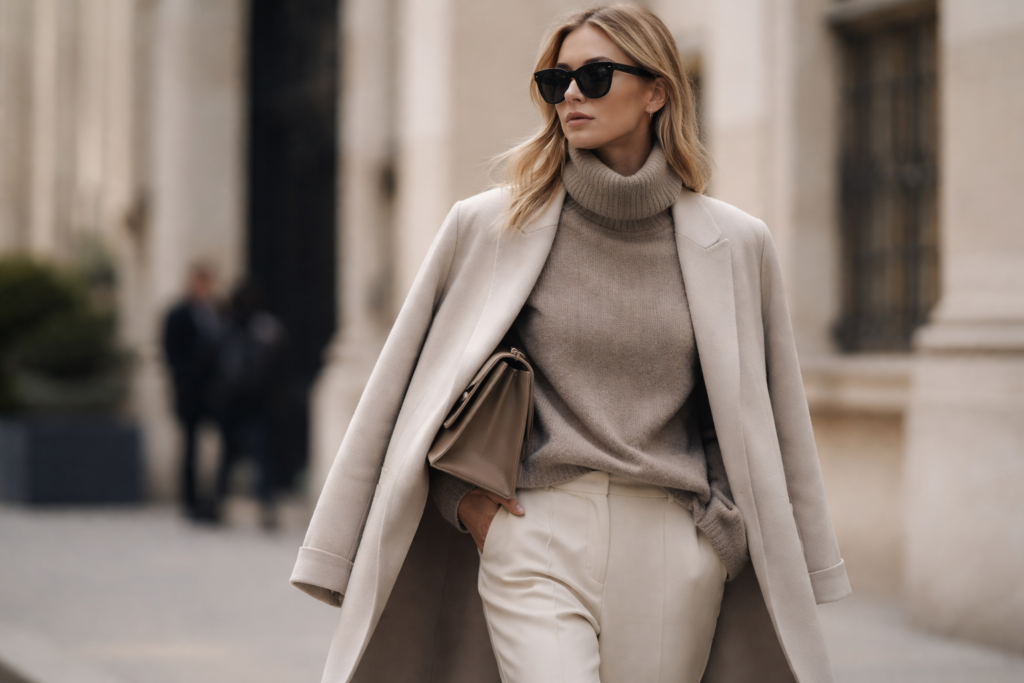
There was a time when wealth liked to announce itself. In the 1980s and early 2000s, luxury fashion was loud—logos stretched across handbags, monograms stamped across belts, and designer names printed so large they could be recognized from across a room. Fashion was not just clothing; it was proof of status.
Today, the language of power in fashion has changed.
The most influential people in the world increasingly dress in ways that are almost invisible. Their clothes are exquisitely made, often extraordinarily expensive, yet they rarely display a logo or a recognizable symbol. To the average observer, the outfit might look simple—even ordinary. But within fashion’s inner circles, it signals something far more powerful: belonging.
This philosophy is known as quiet luxury, a style defined by understated design, exceptional materials, and timeless tailoring rather than obvious displays of wealth. Instead of flashy branding, quiet luxury communicates status through subtle sophistication and craftsmanship.
And in today’s fashion landscape, silence has become the most powerful statement of all.
When Wealth Stopped Shouting
Fashion has always reflected cultural When Wealth Stopped Shouting
attitudes toward money and status. In periods of economic confidence, luxury tends to become theatrical. Designers experiment with bold shapes, bright logos, and dramatic branding because the social mood celebrates visibility.
But cultural shifts can quickly change the tone.
Over the last decade, overt displays of wealth have become increasingly uncomfortable in many social circles. Economic inequality, global uncertainty, and a growing awareness of sustainability have reshaped how people think about consumption. Flaunting luxury suddenly feels outdated—almost vulgar.
In response, the elite adapted.
Instead of abandoning luxury, they refined it.
The result is a wardrobe built around materials rather than marketing: cashmere that feels impossibly soft, tailoring that sits perfectly on the body, leather that ages beautifully over time. Colors are neutral—camel, navy, charcoal, ivory—chosen not for attention but for longevity.
The power of these garments lies in their restraint. Nothing about them shouts. Yet everything about them whispers quality.
The Influence of Cultural Storytelling
Few cultural moments The Influence of Cultural Storytelling
captured this shift better than the HBO drama Succession.
The series follows a fictional billionaire family navigating media empires, corporate warfare, and ruthless ambition. But beyond the narrative, audiences became fascinated with something unexpected: the characters’ wardrobes.
Unlike traditional depictions of wealth, the characters rarely wore recognizable logos. Instead, their clothing consisted of muted sweaters, tailored coats, and minimalist accessories. To most viewers, the outfits looked almost plain. But fashion insiders quickly recognized them as pieces from brands synonymous with quiet luxury, such as Loro Piana and Brunello Cucinelli.
The effect was transformative. For the first time, mainstream audiences were exposed to how the ultra-wealthy actually dress—not for attention, but for recognition among their own social circles.
In other words, the clothes were not meant to impress everyone.
They were meant to impress the right people.
The Rise of Invisible Brands
Perhaps the most fascinating aspect of quiet luxury is that many of its defining brands remain almost invisible to the wider public. These labels rarely rely on bold logos or aggressive marketing. Instead, their reputation is built on craftsmanship, heritage, and exceptional materials. The quiet luxury aesthetic—often associated with brands like Loro Piana and Brunello Cucinelli—focuses on understated elegance, refined tailoring, and fabrics of extraordinary quality rather than visible branding.
Take The Row, the minimalist label founded by Mary-Kate and Ashley Olsen. The brand rarely uses logos, avoids excessive marketing, and focuses almost entirely on fabric quality and precise tailoring. Similarly, Loro Piana has built its reputation on textiles so refined that a sweater may look like any other—but the rare fibers and craftsmanship can make it worth thousands of dollars.
This paradox lies at the heart of quiet luxury: the more understated the clothing appears, the more sophisticated it often is. Luxury becomes less about visibility and more about knowledge—you have to know.
The Psychology Behind Quiet Luxury
Fashion has always functioned as a social language. Throughout history, clothing has helped individuals communicate identity, status, and belonging.
Quiet luxury simply rewrites the grammar of that language.
Instead of saying, “Look at me,” the quiet luxury wardrobe says, “You already know.”
It’s a subtle code shared among those familiar with the world of craftsmanship, heritage brands, and refined taste. For outsiders, the clothing may appear minimal or even boring. For insiders, every detail—from stitching to fabric weight—signals an understanding of luxury culture.
This shift reflects a deeper psychological transformation in fashion consumption.
People are increasingly drawn to pieces that feel permanent rather than seasonal. Instead of buying many trendy items, consumers invest in fewer garments that will last years—or decades. The focus moves away from trends and toward longevity.
Quality replaces quantity.
Social Media and the Paradox of Subtlety
Ironically, the quiet luxury movement has gained enormous visibility through social media.
Platforms like Instagram and TikTok have popularized the aesthetic under names like “old money style” or “stealth wealth.” Influencers dissect outfits worn by billionaires, celebrities, and fictional characters, pointing out subtle cues—an unbranded wool coat, a perfectly cut blazer, a neutral knit that quietly costs more than a designer handbag.
What began as a discreet dress code among elites has evolved into a global fascination.
Yet this popularity also reveals an interesting contradiction. Quiet luxury was originally designed to avoid attention. Now it has become one of the most talked-about fashion aesthetics of the decade.
The quieter it becomes, the louder the conversation grows.
Why the Trend Feels So Powerful
Ultimately, quiet luxury resonates because it reflects something deeper than fashion.
It reflects maturity.
In a world saturated with advertising, logos, and constant digital noise, subtlety has become rare. And rarity is the essence of luxury.
A perfectly tailored coat in a neutral shade may not attract attention in the same way as a bold designer logo. But it carries a different kind of authority—one rooted in confidence rather than validation.
It suggests the wearer does not need to prove anything.
And that, perhaps, is the most powerful message fashion can communicate.
In the end, quiet luxury is not just a style trend. It is a cultural shift—a movement away from spectacle and toward refinement. It reminds us that true elegance rarely demands attention. Instead, it waits quietly to be noticed.
Fashion has always evolved through cultural exchange and shifting power dynamics. As explored in our article on the modern global fashion landscape, the influence of style often travels across borders and societies.